
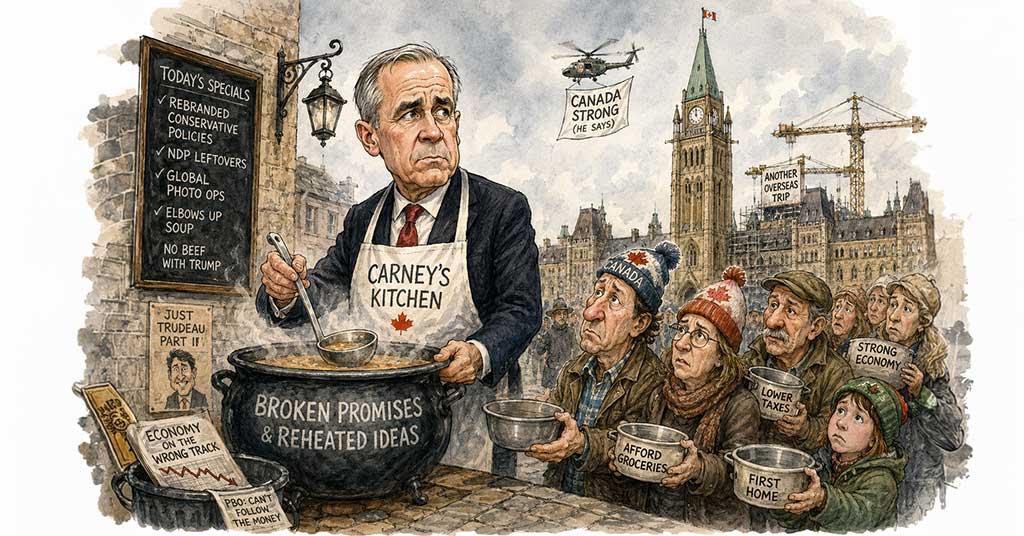
High poll numbers can’t hide the fact that Canadians are losing faith in Carney
It’s reasonable to say that Prime Minister Mark Carney has been on an extended political honeymoon. Longer than most assumed it would have lasted. It’s not over, either.
Carney and his Liberal government have led in almost every public opinion poll in 2026. The one outlier was a Jan. 14 Abacus Data poll, which had them in a statistical tie (40 per cent to 40 per cent) with Pierre Poilievre and the Conservatives. The Liberals motored ahead a couple of weeks later, and it has largely been a double-digit margin since late February.
Here are three recent examples. Nanos Research had the Liberals ahead of the Conservatives by 42.3 per cent to 32.7 per cent in a May 15 poll, or a margin of 9.6 percentage points. Abacus Data suggested the Liberals led by 47 per cent to 35 per cent on May 20, which is a gap of 12 percentage points. Liaison Strategies put the Liberals out in front by 43 per cent to 31 per cent on May 23, which is also 12 percentage points.
Could some of these polls be incorrect? Yes. There’s an understood margin of error in the science of polling of two to three percentage points, so it’s certainly possible.
Could the Liberal lead in the polls be overcome? Yes. Poilievre knows all too well about losing a significant lead in the polls, which was largely due to U.S. President Donald Trump and his tariffs. It’s also happened to other political leaders in our country and around the world.
Could there be a logical explanation for Carney’s surge in the polls? No.
Carney really hasn’t accomplished much of anything since he became prime minister on March 14, 2025. He was unable to take on Trump, in spite of last year’s Ipsos poll during the federal election suggesting he was the best party leader to “stand up” to the president.
Our relationship with the U.S. is at an all-time low, and a significant amount of blame rests on his shoulders. Most of his government’s policies were swiped from the Conservatives, with an additional few from the NDP. The Liberals have spent far too much time either arranging questionable deals with countries like Communist China that may never come to fruition or engaging in political flirtation with the European Union. He has made an unusually high number of trips—18 to 26 different countries—during the past 14 months, and has been criticized for spending more time out of the country than in the House of Commons. His ludicrous “elbows up” campaign that pulled at the heartstrings of delusional Canadian progressives has finally met its demise, too.
What is the appeal of Carney’s leadership, then?
It’s probably a combination of several things. There are Canadians who like him or feel comfortable with him as a leader. There are Canadians who think his background as an economist and former governor of the Bank of Canada and the Bank of England makes up for his lack of political experience. There are Canadians who aren’t particularly fond of Poilievre or any of the other party leaders. There are Canadians who are perfectly fine with mediocre political leaders at the helm, as evidenced by Justin Trudeau winning three elections. There are Canadians who think he’s accomplished a great deal in office, and are completely ignorant of his lacklustre record to date.
Maybe things will change when a majority of Canadians wake up to the realization that the Canadian economy has struggled mightily under Carney’s leadership.
A recent poll from Canada Pulse Insights for CityNews revealed that 67 per cent of respondents believe that our national economy is on the wrong track. “Only 33 per cent believe the economy is heading in the right direction,” according to this poll, and “only three in 10 believed that the national or their local economy would improve over the next 60 days.” Alberta had the highest percentage at 73 per cent, followed by the Prairies and Atlantic Canada (69 per cent), Ontario (68 per cent), B.C. (65 per cent) and Quebec (64 per cent).
While this data has had virtually no effect on the Liberal government’s rise in the polls to date, it does seem to be having a small effect on the prime minister’s personal popularity.
David Valentin, principal at Liaison Strategies, noted on May 4 that his firm’s Weekly Federal Tracker found “Carney’s approval has softened slightly this week, with 60 per cent approving and 32 per cent disapproving.” He acknowledged that it’s “still a very strong score, but it is no longer quite as frictionless as it was in earlier weeks.” Hence, Liaison will be “keeping our eye carefully on this to see if it is the start of a new trend or just a weekly blip.”
While the two things don’t necessarily go hand in hand in polling, they usually come together and affect a government’s perceived performance on issues and files. It’s also worth noting that the Parliamentary Budget Officer critiqued missing information in the Carney Liberals’ spending plans and comprehensive expenditure review, making it difficult for the watchdog to “follow the money.”
It’s hard to conceive how Canadians will maintain high degrees of confidence in the Liberals if these concerns about our domestic economy and question marks about actual government spending remain. The façade that Carney has created is beginning to reveal itself to people who either didn’t know better or didn’t want to know better. That’s why the prime minister’s extended political honeymoon may finally be coming to an end.
Michael Taube is a political commentator, Troy Media syndicated columnist and former speechwriter for Prime Minister Stephen Harper. He holds a master’s degree in comparative politics from the London School of Economics, lending academic rigour to his political insights.
Explore more on Canadian economy, Liberal government, Federal politics
The views, opinions, and positions expressed by our columnists and contributors are solely their own and do not necessarily reflect those of our publication.
Troy Media empowers Canadian community news outlets by providing independent, insightful analysis and commentary. Our mission is to support local media in helping Canadians stay informed and engaged by delivering reliable content that strengthens community connections and deepens understanding across the country.

