
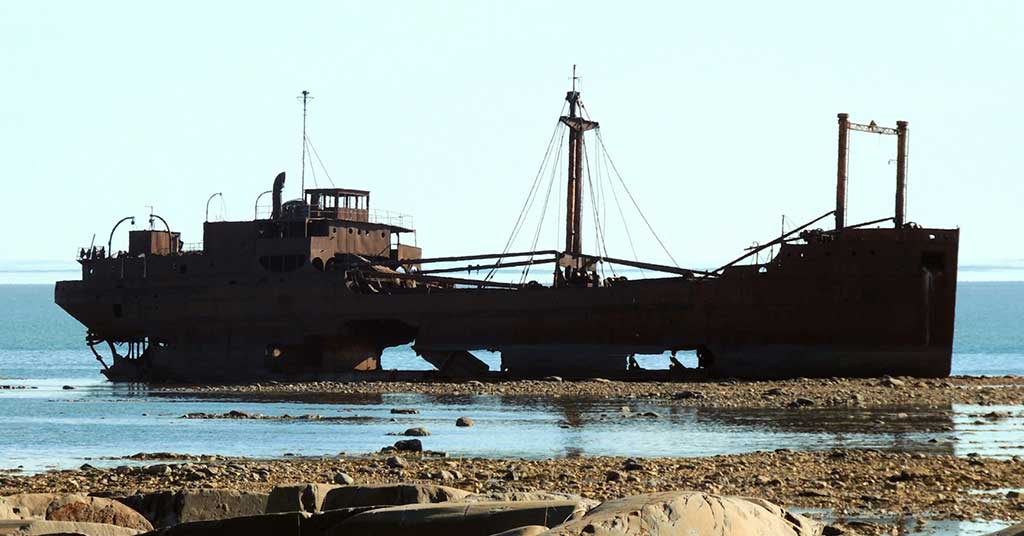
Churchill and Port Nelson could give Prairie producers a better route to overseas customers
While Mark Carney was trying to convince the world’s money managers to invest in Canada, an important conference in Winnipeg was dealing with a more basic problem: how do we get Canadian products and resources to the customers who want them?
The Frontier Centre for Public Policy held a two-day conference on northern transportation, national security and Hudson Bay as a shipping terminus.
A dozen experts on subjects ranging from ice conditions and Indigenous economics to manufacturing and port locations shared their extensive experience of the challenges involved in a much-needed return to shipping through the Bay. The audience was made up of potential investors and policymakers from Alberta, Saskatchewan, Ontario and, of course, Manitoba.
The Prairies and even the northwestern United States are landlocked, leaving them at the mercy of crowded eastern, western and southern ports that are expensive to reach and to use. Imagine having access to the North, where we can reach the European market at least a day earlier and where CentrePort Canada offers duty and tax advantages for qualifying goods being shipped through Canada to foreign markets.
There was strong consensus that more than one port is needed. Shippers must have a fail-safe before a remote location becomes attractive as a cheaper and faster way to deliver imports and pick up exports. While Churchill, Canada’s only Arctic deepwater port served by rail, has its uses and still has a place in the transport of some domestic products, especially to Nunavut, a second port is needed. Port Nelson (or rather a site being called New Port Nelson, a few kilometres up the coast from the mouth of the river) is the favoured location.
The port would be built out into the Bay to deep water, where it would avoid the silt near the shoreline as well as calving belugas and seal-hunting polar bears. Roberts Bank at the Port of Vancouver was cited as an example: it extends 5.5 kilometres out to deep water to accommodate today’s larger cargo ships. Interestingly, ships serving the Port of Thunder Bay, to the south, can carry approximately 35,000 tonnes because of the locks they must traverse, while the ships needed to move energy and minerals economically carry loads many times heavier.
So, if we look at Hudson Bay as a port region, as the National Centre of Excellence and Innovation in Maritime Security suggests, the case for two ports becomes much clearer. Allan McDougall, the report’s chief author and a presenter at the conference, explains why: “Adopting the competitive approach and maintaining a single port (Churchill) in the Hudson Bay area creates risks that may be unacceptable to shipping companies. This is mainly due to the unique circumstance that the Port of Churchill is isolated. The creation of the NeeStaNan/Port Nelson infrastructure, supported by a road network, can act as a relief valve …”
Robyn Lore, the proponent partner of the NeeStaNan Group, spoke about the economic advantages of a second port. NeeStaNan is proposing a new transportation corridor linking the Prairies to Port Nelson by road and rail.
Port Nelson would be a far more efficient choice, as it is much closer to major customers such as Brazil and Ukraine. Lore noted that Canada lost $20.5 billion in 2018 alone to price differentials, largely because we relied on U.S. refining and shipping of our raw product. He also cited the loss of Nutrien’s potash exports, which will ship through Washington state instead of a viable Canadian port. Lore also pointed out the advantages for northern Manitoba, where his majority-owner First Nations partners will gain a self-supporting economy through the many developments that will come with construction of the road, the rail line and the port itself, along with ancillary services.
Natural gas could also be transported to Port Nelson, the new port the Indigenous community would own. Blaine Mersereau of Wapusk LNG explained how the gas could be liquefied in Saskatchewan, then carried to the Bay by rail in cryogenic tank cars to a permanent terminal: a decommissioned tanker moored at the end of the Port Nelson pier and constantly refilled to serve exporting tankers. This could be up and running as early as 2031, a much shorter time frame than any pipeline, although a pipeline could also be built for the long term.
Not to be overlooked was the encouragement from Indigenous leaders, former chief Ron Evans and former Liberal MP Robert-Falcon Ouellette. As Ouellette pointed out, “The strongest projects will be built with Indigenous nations from the beginning.” That is exactly the case with the NeeStaNan Group, which has included Fox Lake Cree Nation and many others from the very start. Evans made the same point: “Consent in this country has an address. It is not in Ottawa, and it was never at the AFN.” The message from both was clear: First Nations are eager to take part in economic projects, but not as an afterthought. That is more than fair and should be obvious to everyone.
The NeeStaNan project is now with the federal Major Projects Office, which was set up to speed major projects through the federal approval process. It is further along than many of the 167 proposals. It is time for Manitoba to get a win. With Churchill and Port Nelson working together, the best answer to getting Prairie resources to world markets is within reach.
Dorothy Dobbie, Member of the Order of Canada, is a publisher, entrepreneur, former member of Parliament and longtime leader in Canadian public life. She is a member of the board of directors of the Frontier Centre for Public Policy.
Explore more on Transportation, Infrastructure, Trade, Arctic, Aboriginal Business
The views, opinions, and positions expressed by our columnists and contributors are solely their own and do not necessarily reflect those of our publication.
Troy Media empowers Canadian community news outlets by providing independent, insightful analysis and commentary. Our mission is to support local media in helping Canadians stay informed and engaged by delivering reliable content that strengthens community connections and deepens understanding across the country.

